
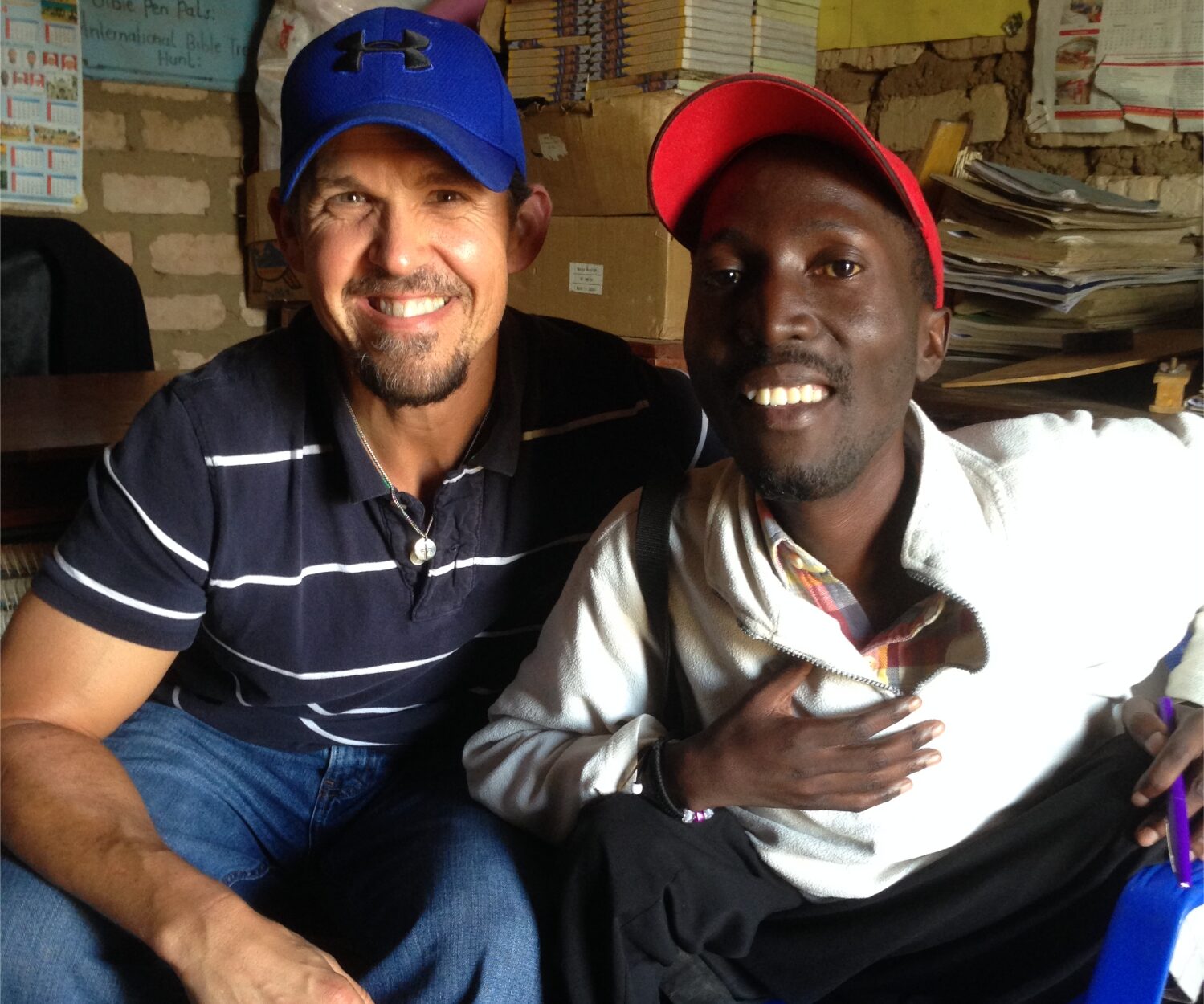
By Chris Tarwater
Tonnie Wasajja was born on December 7, 1990, in Masaka, Uganda. He was the second son of Mr. and Mrs. Wasajja and grew up in a large and loving family of seven boys and two girls. From an early age, his father was intentional about shaping in him the mindset of a leader. Even though Tonnie faced physical limitations later in life, his father believed that strength of character mattered more than physical stature—and he raised Tonnie to believe the same.
The first time I met Tonnie was in 2016, and nothing could have prepared me for the profound impact he would have on my life. I was serving as part of a Shupavu mission team, and our task that day was to visit local schools, encourage the students in their studies, strengthen peer relationships, and inspire families to take an active role in their children’s education.
Tonnie’s father had originally been scheduled to escort our team to the schools. However, when one of his sons fell ill in Kampala, he instead sent Tonnie in his place. At the time, I did not realize the depth of Tonnie’s relationship with the local community or his involvement with the Ugandan Shupavu team. I simply assumed he was kindly “filling in” for his father. I knew little about his personal circumstances, his family background, or the challenges he had faced. Yet from the outset, I could see his respectful demeanor, humble spirit, and the sincere compassion that flowed so naturally from him. Even in his physically limiting condition, Tonnie radiated a deep love for people.
It was only later that I came to learn the rest of his story. Tonnie had been born healthy, but at four years old he fell ill. The illness permanently affected his growth, leaving him with significant physical restrictions. But in the Wasajja household, disability was never permitted to define destiny. His father consistently reminded him that while his body might be limited, his mind, spirit, and potential were not. Tonnie was taught to face each day with courage, adapt where necessary, and rise above his circumstances.
I finally asked the question that had been in my heart:
“Tonnie, how do you do it?”
He looked at me gently. “Do what, Chris?”
“I mean this respectfully,” I said. “We both know you have physical limitations. You can’t stand fully upright, and your legs don’t stretch as they should. And yet, nothing seems to hold you back. You are always joyful. Always hopeful. How do you stay so positive?”
He smiled and said simply, “I choose.”
“I choose to only look at the positive. I refuse to dwell on the negative. I have chosen to live in the positive. This is what I can do.”
I was humbled. In that moment, Tonnie became one of the greatest teachers I have ever known. Not by lecture. Not by theory. But by the quiet power of a life courageously lived.
Our mission that year focused on raising awareness about persons with special needs within Ugandan communities. Looking back, I can now see how divinely orchestrated it was that Tonnie became part of that mission. Shupavu (a Swahili word meaning courageous) had been visiting this community for some time—but 2016 was both Tonnie’s first year and mine. And when I met him, I sensed the Lord whispering to my heart, “This is your mission.” In that instant, I realized I had come all the way to Masaka, Uganda for a reason far greater than I expected: God had brought me there to meet Tonnie.
From then on, I purposed in my heart to continue supporting the Shupavu mission. We returned in 2018, and I eagerly shared Tonnie’s story with others. Together, we served communities in Masaka and beyond, inspired by his example of resilience and joy.
Then, in 2024, I received devastating news. Tonnie had passed away under mysterious circumstances. The grief struck me deeply. It felt as though a beautiful journey had ended far too soon.
But the measure of a life is often revealed in its legacy. More than two thousand mourners attended Tonnie’s burial, including community leaders and political dignitaries. His name had spread far and wide—not because of fame, wealth, or power—but because of the kindness, courage, and servant heart he shared with everyone he met.
For me, Tonnie remains an uneraseable memory—a reminder that our greatest strength is not found in our bodies, but in our choices, our faith, and our love for others. Through his life, I learned that true courage is choosing joy, even when life places limits on what the body can do. And that is why I will never forget him.
Though he is gone from this world, Tonnie’s life continues to inspire. His posthumous biography, to be launched in 2026, will tell the full story of this remarkable young man whose physical limitations never limited his spirit.
Leave a Reply